Heartbeat Theater
What It Actually Was
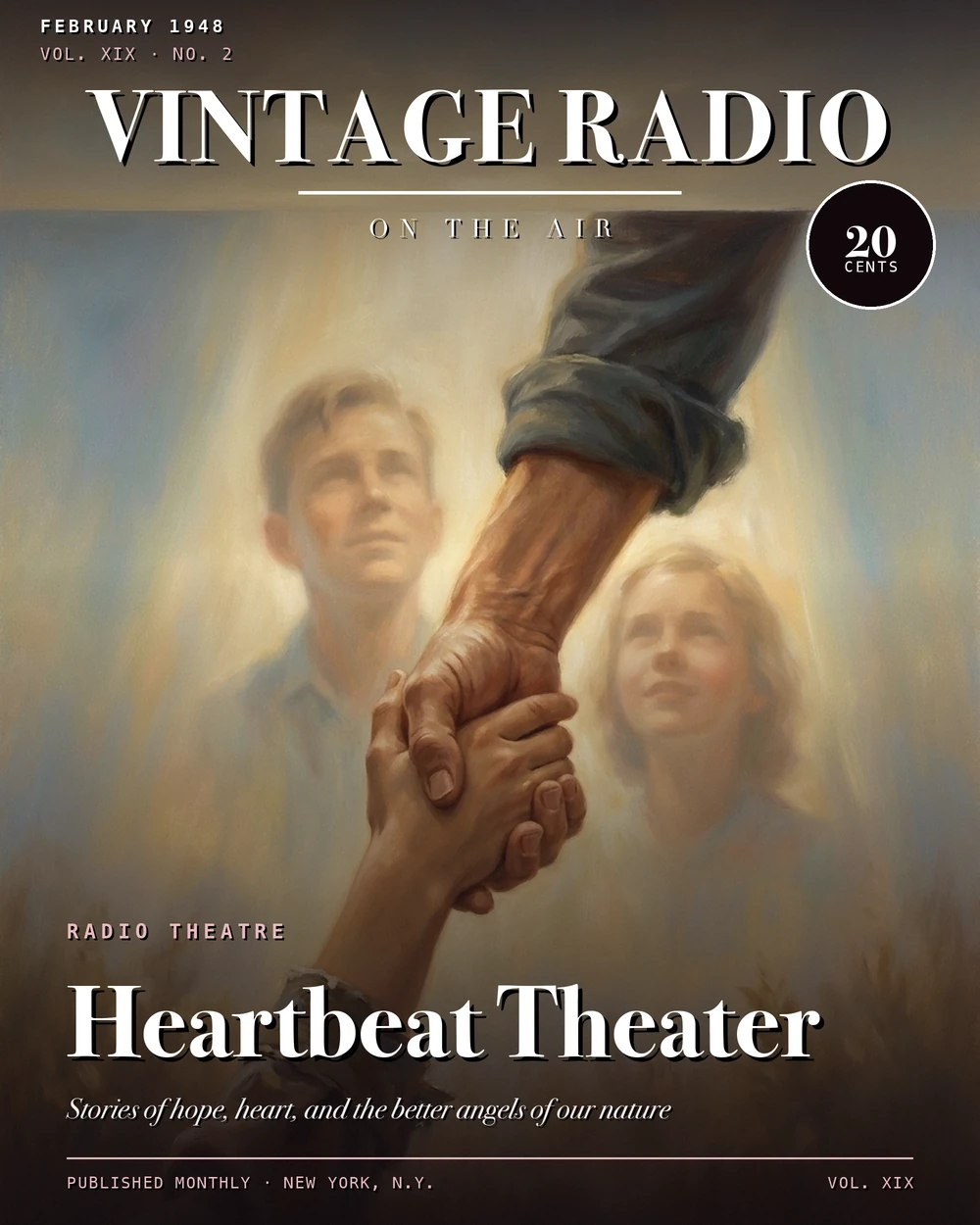
Heartbeat Theater is one of those shows that doesn't fit neatly into the usual old-time radio categories. It wasn't a commercial network drama chasing ratings or an adventure serial selling breakfast cereal. It was a Salvation Army-sponsored drama with a specific public-service mission: to tell stories about ordinary people navigating illness, tragedy, heartbreak, and moral failure — and to show how faith, community, and human decency could carry them through. The C.P. MacGregor Company, a Hollywood production house founded in 1929 by Charles P. MacGregor and Sigurd A. Sollie, produced the series. The first episode was produced in December 1955 and released in March 1956, and the show ran continuously through 1985 — nearly three decades, making it one of the longest-running radio drama programs in American broadcasting history.
The content was broader and more serious than the show's inspirational framing might suggest. Episodes tackled bigotry, alcoholism, murder, suicide, train wrecks, small-town gossip, and loneliness alongside the faith elements — Bible verses, the power of prayer, characters who were Salvation Army officers or residents of Salvation Army-sponsored homes. The approach was described by those involved as "neither pushy nor preachy," and the range of subject matter backed that up. This was not a show that looked away from the harder parts of human experience.
How It Got Made
The C.P. MacGregor Company relocated from San Francisco to Los Angeles in 1936 and spent decades producing music and dramatic programming out of its StudioHouse facility in Hollywood. Heartbeat Theater was among the company's longest-running projects, with Don Hills and George Galbraith producing the series from that Hollywood base. Hills was especially central — he is credited with writing approximately 52 episodes per year, which amounts to essentially the entire annual run by himself. It's a workload that's hard to wrap your head around: a new half-hour script every week, year after year, for a show that didn't repeat itself.
Narrators and hosts changed across the show's long life. C.P. MacGregor himself served as a narrator, as did Marvin Miller. The best-known host was Macdonald Carey, familiar to later television audiences as Dr. Tom Horton on Days of Our Lives. Carey hosted the series for a significant stretch and narrated the final episode, taped on October 10, 1985. That last session also featured Daws Butler, the voice actor known for his cartoon character work, in one of the program's final performances.
The Guests Who Showed Up
For a show that operated outside the commercial network structure, Heartbeat Theater attracted a notable roster of performers over the years. Preston Foster is believed to have appeared in the first episode. Raymond Burr and Greer Garson came through as well, and sources from the time noted that "all sorts of famous people appeared on the show." The anthology format, with a fresh cast for each self-contained episode, made guest appearances a natural fit — no long-term character commitments, just one strong story at a time.
The episode catalog reflects that variety. Titles in the known record include "Memory of Tomorrow," "The Sour Drum Song," "The Last Witness," "Family Album," "The Private World Of Tommy," "Once a Thief," "The Education Of Mr Phipps," "The Lie," "A Comeback At Twilight," and "In His Footsteps," among others. Each was a standalone drama, and the range of titles suggests the writers were covering substantial thematic ground from week to week.
The Reach and the Cost
At its peak, Heartbeat Theater was distributed to approximately 500 U.S. radio stations. That's a significant footprint for a non-commercial, faith-sponsored program competing in a landscape where television had already pulled audiences away from radio drama. The Salvation Army reportedly spent half its annual media budget keeping the half-hour drama alive — a remarkable commitment that reflects how seriously the organization took the show as an outreach and fundraising vehicle.
That investment eventually ran out. In 1977 and 1978, the Salvation Army revitalized the series by updating its sound effects and directing it toward more contemporary social issues, renaming it New Heartbeat Theatre for that phase of its run. The renewal extended the show's life by another several years, but the Salvation Army ultimately cut the program from its budget, and the final episode was taped on October 10, 1985. The episode record in this catalog contains 48 known broadcasts, spanning from February 2, 1958 to May 9, 1976.
What Survived
The Library of Congress holds the Heartbeat Theatre Radio Scripts Collection as part of the larger C.P. MacGregor Collection at the National Audio-Visual Conservation Center. The scripts are dated 1957 through 1985 and span approximately 22,050 items across 63 containers — a substantial archive for any radio program. The finding aid notes that the first fifty scripts are not included and that some gaps exist, though the New Heartbeat Theatre portion is complete.
The show's status as reportedly "the last live, regularly scheduled radio drama produced in Hollywood" gives it a particular place in the history of the medium. Most radio drama was long gone by the late 1970s and early 1980s, replaced by music formats, news, and talk. Heartbeat Theater kept going, sustained by a sponsor with a specific mission and a production team in Hollywood willing to keep making it. Don Hills, who maintained that extraordinary pace of writing and producing through the run, also produced The Zero Hour drama series for the Mutual Broadcasting System — another signal that StudioHouse was home to people who took radio drama seriously long after the rest of the industry had moved on.